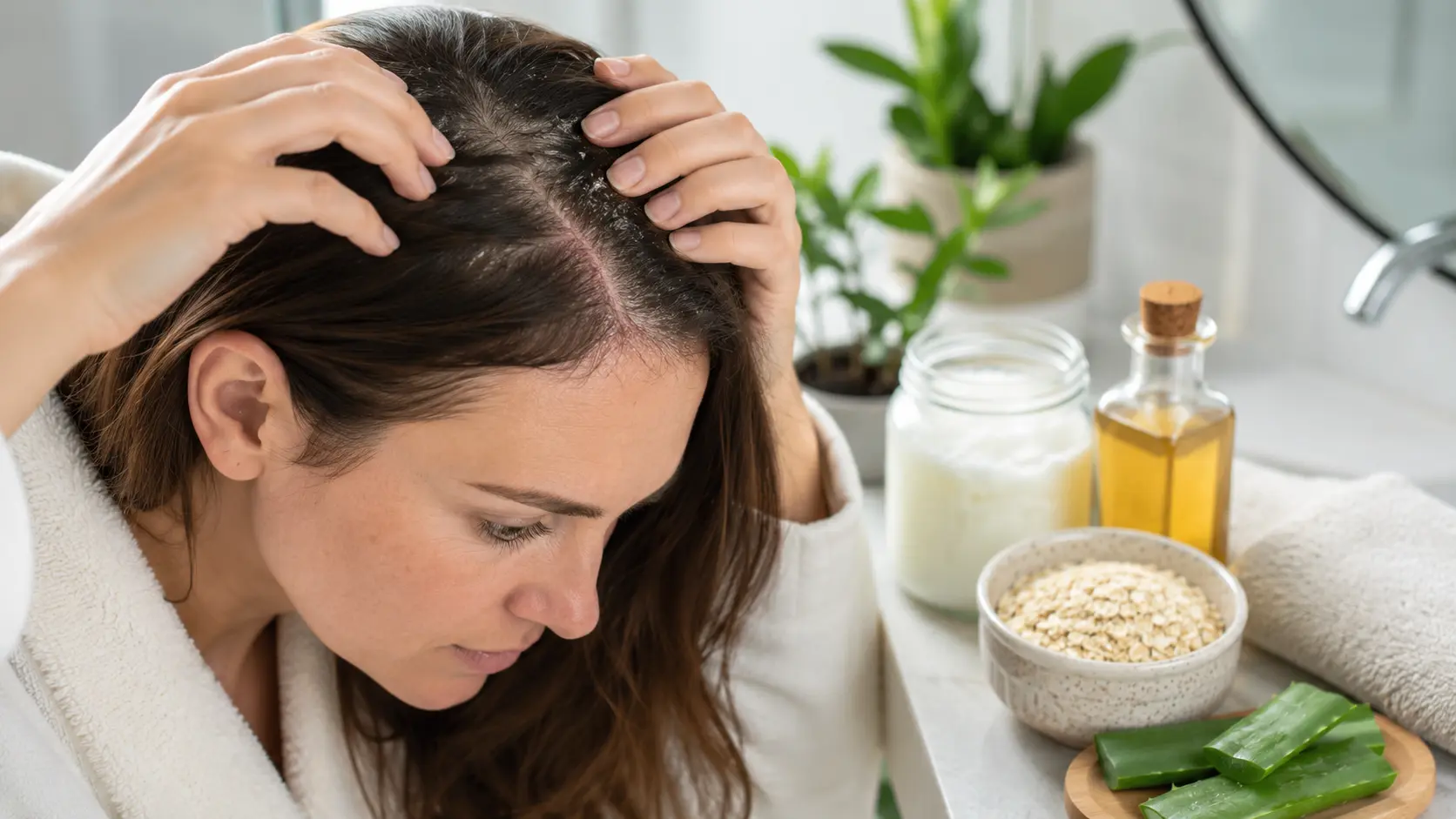
An itchy, flaky scalp can be frustrating.
When the flakes keep returning despite switching shampoos, using scalp scrubs, or washing more frequently, the problem may be more than ordinary dandruff.
Scalp psoriasis is a chronic inflammatory skin condition that can cause thick scaling, itching, burning, soreness, and visible patches on or around the scalp. It may also affect the skin behind the ears, along the hairline, or at the back of the neck.
Natural remedies cannot cure scalp psoriasis or correct the underlying immune activity that causes it.
However, some gentle home-care methods may help soften scales, reduce dryness, calm itching, and make the scalp more comfortable between medical treatments.
The key is to treat the scalp gently. Scratching, picking, scrubbing, and experimenting with harsh viral remedies can injure the skin and make a flare worse.
Here are nine natural or low-intervention approaches that may help relieve scalp psoriasis symptoms without causing unnecessary irritation.
What Is Scalp Psoriasis?
Scalp psoriasis is a form of psoriasis that develops on the skin beneath the hair.
Psoriasis causes skin cells to accumulate more rapidly than usual, resulting in raised, scaly, inflamed patches.
Common symptoms include:
- Dry or silvery-white scales
- Thick, crusted plaques
- Itching, burning, or soreness
- Dandruff-like flaking
- Inflamed or discolored patches
- Temporary hair shedding
- Bleeding after scratching or forceful scale removal
Symptoms can range from a small, barely noticeable patch to extensive scaling across most of the scalp.
Flares may come and go, and their severity can change over time. Stress, cold weather, dry air, scalp injuries, and certain hair-care practices may contribute to worsening symptoms.
Scalp psoriasis may look similar to dandruff or seborrheic dermatitis. However, psoriasis often produces thicker, more defined scaling and may extend beyond the hairline.
Seborrheic dermatitis is more commonly associated with greasy white or yellow scales.
Because the conditions can overlap in appearance, a dermatologist may be needed to confirm the diagnosis.
Can Natural Remedies Get Rid of Scalp Psoriasis?
No natural remedy has been shown to permanently eliminate scalp psoriasis.
Home remedies may provide temporary relief by:
- Moisturizing dry skin
- Softening attached scales
- Reducing the urge to scratch
- Cooling an irritated scalp
- Supporting gentler scale removal
- Reducing exposure to irritating hair products
These measures are best viewed as supportive care rather than substitutes for medical treatment.
For moderate or severe scalp psoriasis, dermatologists frequently prescribe topical corticosteroids because they can quickly reduce inflammation, itching, redness, and scaling.
Other established options include salicylic acid, tar-based products, vitamin D–related medications, phototherapy, and systemic medicines.
1. Soften Scales With Coconut Oil or Mineral Oil
Coconut oil and mineral oil may help moisturize a dry scalp and soften thick, attached scales.
They do not treat the immune process behind psoriasis, but softened scales are often easier to remove without scraping or pulling at the skin.
To try an oil-based pre-wash treatment:
- Place a small amount of oil in your hands.
- Rub your hands together to warm it slightly.
- Apply the oil directly to the affected scalp areas.
- Leave it on for approximately 20 to 60 minutes.
- Wash it out with a gentle shampoo.
- Remove only the scales that loosen easily.
Avoid heating the oil until it is hot. Excessive heat can burn or irritate an already inflamed scalp.
Use only enough oil to coat the affected skin.
Heavy application may be difficult to wash out and can contribute to buildup around the hair follicles. Discontinue use if you notice increased redness, acne-like bumps, burning, or itching.
Before using coconut oil or any botanical product widely, perform a patch test on a small area. Even products marketed as natural can cause irritation or allergic reactions.
2. Try Diluted Apple Cider Vinegar for Itching
Apple cider vinegar is one of the most commonly discussed home remedies for scalp psoriasis.
Some people find that it temporarily reduces itching, although it does not remove psoriasis plaques or control the underlying condition.
The National Psoriasis Foundation suggests diluting apple cider vinegar with water in a one-to-one ratio when burning is a concern.
It should not be used on skin that is cracked, raw, bleeding, or covered with open wounds.
A cautious method is to:
- Mix equal parts apple cider vinegar and water.
- Apply a small amount to an intact area of affected scalp.
- Leave it on briefly.
- Rinse thoroughly after it dries.
- Stop immediately if it causes significant burning or pain.
Mild tingling may occur, but intense stinging is a warning that the scalp is too irritated for this remedy.
Do not assume that discomfort means the product is working. Burning can indicate additional skin-barrier damage.
Apple cider vinegar should never replace prescribed medication, and frequent use may be too irritating for sensitive or severely inflamed skin.
3. Apply Pure Aloe Vera Gel
Aloe vera gel may provide a cooling sensation and temporary relief from dryness, tightness, or mild irritation.
Choose a simple gel that is:
- Fragrance-free
- Alcohol-free
- Free from added dyes
- Formulated for sensitive skin
Apply a small amount to a limited section of the scalp first. Leave it in place only if it feels comfortable and does not increase redness, burning, or itching.
Aloe vera should be described as a soothing skin-care option, not a cure. Evidence for natural and complementary psoriasis products remains more limited than evidence for established medical treatments.
Products containing aloe may also include fragrances, drying alcohols, menthol, or other ingredients that irritate sensitive skin.
Reading the entire ingredient list is more important than relying on the word “aloe” on the front label.
4. Use a Cool, Damp Compress
For sudden itching or burning, a cool compress may be one of the simplest ways to obtain temporary relief.
Cold temperatures can reduce the transmission of itch signals through the nerves, helping decrease the urge to scratch.
The American Academy of Dermatology recommends applying a cool, damp washcloth to itchy psoriasis-affected skin.
To use a compress:
- Wet a clean washcloth with cool water.
- Wring out the excess water.
- Hold it gently against the affected area for 5 to 10 minutes.
- Remove it and pat the area dry.
Do not apply ice directly to the scalp. Direct ice contact can injure the skin, especially when the skin barrier is already compromised.
This technique can be particularly helpful after heat exposure, exercise, sweating, or an episode of intense itching.
It does not treat the psoriasis itself, but it may help prevent the scratching that often worsens plaques.
5. Choose Fragrance-Free, Gentle Hair Products
The products used between flares can be just as important as the remedies used during a flare.
Strong fragrances, clarifying shampoos, abrasive scalp scrubs, alcohol-heavy sprays, chemical relaxers, bleaching products, and high-heat styling may irritate sensitive scalp skin.
Look for shampoos, conditioners, and styling products labeled:
- Fragrance-free
- Suitable for sensitive skin
- Gentle or mild
- Free from harsh physical exfoliants
“Fragrance-free” is generally more useful than “unscented.” An unscented product may still contain masking fragrances.
Wash with warm or lukewarm water instead of very hot water. Prolonged water exposure and hot showers can increase dryness and itching.
When shampooing, use the pads of your fingertips instead of your fingernails.
Rub the hair gently rather than aggressively massaging, scratching, or scrubbing the scalp. Dermatologists warn that friction and scratching can worsen scalp psoriasis.
Be equally cautious with blow-dryers, curling irons, hot rollers, and flat irons. High heat or direct contact with the scalp may trigger irritation or a new flare.
6. Consider Colloidal Oatmeal for Soothing Relief
Colloidal oatmeal is finely ground oatmeal designed to mix into water or skin-care products. It is commonly used to soothe dry and itchy skin.
For the scalp, oatmeal treatments can be somewhat messy.
A fragrance-free scalp product containing colloidal oatmeal may be more practical than applying a homemade paste.
A simple at-home approach is to:
- Combine colloidal oatmeal with lukewarm water.
- Apply a thin mixture to accessible affected areas.
- Leave it on briefly.
- Rinse the scalp completely.
- Follow with a gentle shampoo if residue remains.
Do not rub oatmeal particles into the plaques as a physical scrub. The objective is to soothe and moisturize the skin, not mechanically exfoliate it.
Oatmeal-based moisturizing approaches may help some people with psoriasis-related itching, flaking, and scaling, but they should not be expected to clear thick plaques on their own.
People with an oat allergy should avoid colloidal oatmeal products.
7. Use Tea Tree Oil Only With Caution
Tea tree oil is frequently promoted on social media as a natural solution for scalp flaking.
It is included in some shampoos and scalp products, but evidence supporting it specifically as a treatment for psoriasis remains limited.
Concentrated tea tree oil can cause:
- Burning
- Redness
- Dryness
- Allergic contact dermatitis
- Worsening irritation
Never apply undiluted tea tree essential oil directly to an inflamed scalp.
The National Psoriasis Foundation advises diluting tea tree oil or combining it with a carrier oil rather than applying it in concentrated form.
The organization also notes its use in shampoos intended to reduce flaking and itching.
A pre-formulated shampoo containing a low concentration of tea tree oil is generally easier to use safely than attempting to mix a homemade essential-oil treatment.
Before using it:
- Patch-test the product.
- Avoid broken or bleeding skin.
- Keep it away from the eyes.
- Stop if symptoms worsen.
- Do not combine several essential oils at once.
A product does not become automatically safe because it is plant-based. Essential oils are concentrated substances and can irritate reactive skin.
8. Remove Scales Gently—Never Pick or Scratch
Removing thick scales can help medication reach the affected skin, but aggressive removal can create a cycle of injury, inflammation, and further scaling.
The safest approach is to soften first and remove only what releases easily.
Try this sequence:
- Apply an oil or dermatologist-recommended scale softener.
- Allow the product enough time to soften the buildup.
- Shampoo the scalp gently.
- Use a soft comb only if the scales are already loose.
- Stop if removal causes pain, bleeding, or resistance.
Do not use fingernails, hard scalp brushes, metal combs, or rough exfoliating tools to lift attached plaques.
Picking and scraping can trigger a psoriasis flare. Forceful scale removal can also pull out hairs and cause temporary hair loss.
Hair commonly grows back after the scalp inflammation is controlled, but continued trauma may prolong shedding.
When detangling, work slowly from the ends of the hair toward the roots. Avoid tight ponytails, braids, extensions, or hairstyles that place additional tension on an irritated scalp.
9. Identify and Reduce Personal Flare Triggers
Scalp psoriasis does not have one universal trigger.
What worsens symptoms for one person may have little effect on another.
Potential triggers may include:
- Emotional stress
- Cold or dry weather
- Scalp scratching or injury
- Harsh hair treatments
- Smoking
- Heavy alcohol use
- Infections
- Changes in medication
- Inconsistent psoriasis treatment
- Heat and sweating
Stress and dry, cold conditions are commonly associated with psoriasis flares.
A symptom diary can help identify patterns. For two to four weeks, record:
- Scalp symptoms
- New hair products
- Wash frequency
- Stress levels
- Weather changes
- Sleep quality
- Alcohol consumption
- Medication changes
- Recent illnesses
- Hair coloring or chemical treatments
Avoid making major dietary restrictions based only on social-media claims.
There is no single food that universally causes scalp psoriasis.
Any major diet change should be nutritionally balanced and discussed with a qualified healthcare professional, particularly if you take medication or have another medical condition.
A Simple At-Home Scalp Psoriasis Routine
A consistent, gentle routine is usually safer than rotating through several new remedies.
Before Washing
Apply a small amount of coconut oil, mineral oil, or a dermatologist-recommended scale softener to thick plaques. Allow enough time for the scale to soften.
Do not scrape or pick while the plaques are still firmly attached.
During Washing
Use warm or lukewarm water.
Apply shampoo directly to the scalp and massage lightly with the fingertips. Avoid digging in with the fingernails.
When using a medicated shampoo, follow the label or prescription instructions. Some products need to remain on the scalp for several minutes before rinsing.
Rinse thoroughly. Shampoo left on the scalp may contribute to irritation.
After Washing
Pat the hair dry instead of rubbing it aggressively.
If you use a prescribed scalp solution, foam, oil, or spray, apply it exactly as directed. Part the hair in small sections so the medication reaches the skin rather than coating only the hair.
Use a low or cool heat setting when blow-drying. Keep the dryer away from the scalp.
Over-the-counter salicylic acid and tar-based shampoos are not usually classified as natural remedies, but they are established options for mild scalp psoriasis.
Salicylic acid helps soften and remove scales, while tar products may help reduce scaling and itching.
Natural Remedies That May Make Scalp Psoriasis Worse
Social media is filled with psoriasis “hacks,” but several popular remedies can damage the scalp barrier or intensify inflammation.
Undiluted Essential Oils
Peppermint, eucalyptus, lavender, rosemary, and tea tree oils can all cause irritation or allergic reactions when applied in concentrated form.
Lemon Juice or Other Strong Acids
Lemon juice may sting cracked skin and increase irritation. It can also make skin more sensitive to sunlight.
Baking Soda Scrubs
Baking soda is alkaline and can be drying. Scrubbing it into plaques adds mechanical friction to already inflamed skin.
Sugar, Salt, or Coffee-Ground Scrubs
Rough particles can tear the skin, create bleeding, and provoke additional inflammation.
Extremely Hot Oil Treatments
Hot oil can burn the scalp. Use oil only at room temperature or slightly warmed between the hands.
Aggressive Brushing
Hard bristles and forceful brushing may scrape plaques, worsen inflammation, and increase hair shedding.
Picking With Fingernails
Picking creates small wounds and can cause bleeding. It may also make plaques thicker and more difficult to manage.
Applying Several Remedies at Once
Using vinegar, essential oils, exfoliating products, and medicated shampoo on the same day makes it difficult to determine which product caused a reaction.
Introduce only one new product at a time and monitor the scalp closely.
Stopping Prescription Treatment Without Guidance
Natural care should complement—not abruptly replace—medical treatment. Stopping a prescribed medicine may allow symptoms to return or worsen.
Remember: natural does not always mean scalp-safe. If a remedy burns, stings, or requires aggressive scrubbing, stop using it.
When Home Remedies Are Not Enough
Consult a dermatologist or another qualified healthcare professional when:
- Symptoms are spreading.
- Plaques are becoming thicker or more painful.
- The scalp is bleeding, oozing, or crusting.
- You notice pus, warmth, swelling, or signs of infection.
- Itching regularly disrupts sleep.
- Hair loss is persistent or extensive.
- Over-the-counter care is not helping.
- You are uncertain whether the problem is psoriasis.
- Psoriasis affects large areas of skin.
- Symptoms interfere with work, relationships, or daily activities.
Medical evaluation is also important if you develop joint pain, swelling, stiffness, heel pain, or swollen fingers or toes.
Psoriasis can occur alongside psoriatic arthritis, a condition that can damage joints if it is not treated.
Medical Treatments a Dermatologist May Recommend
Scalp psoriasis can be difficult to treat because the hair makes it harder for medication to reach the skin.
Dermatologists often choose formulations specifically designed for the scalp.
Depending on severity, treatment may include:
- Prescription corticosteroid solutions, foams, sprays, oils, or shampoos
- Vitamin D–based topical medication
- Salicylic acid scale softeners
- Tar-based shampoos
- Other nonsteroidal topical medicines
- Phototherapy
- Oral systemic medication
- Injectable biologic treatment
Topical corticosteroids are frequently used because they act quickly against inflammation, itching, redness, and scaling.
More extensive or treatment-resistant psoriasis may require phototherapy or medication that works throughout the body.
The most effective plan depends on the severity of the condition, the extent of skin involvement, medical history, other medications, and how significantly psoriasis affects daily life.
Final Takeaway
Natural remedies for psoriasis on the scalp can help make symptoms more manageable, but they should be used with realistic expectations.
The safest strategies focus on protecting the scalp rather than attacking every visible flake:
- Soften scales before removing them.
- Use cool compresses for temporary itch relief.
- Wash with warm water and gentle products.
- Avoid scratching, scraping, and harsh exfoliation.
- Patch-test oils and botanical products.
- Treat essential oils as potential irritants.
- Continue evidence-based treatment as directed.
- Seek professional care when symptoms persist or worsen.
Scalp psoriasis is a chronic medical condition, not a hygiene failure. Washing harder, scratching more, or trying increasingly aggressive remedies usually does not solve it.
The goal is to calm inflammation, protect the skin barrier, minimize trauma, and build a routine that keeps flare-ups under better control.
Medical disclaimer: This article is for informational purposes only and is not a substitute for professional medical advice, diagnosis, or treatment. Consult a qualified healthcare professional before trying a new scalp treatment, especially if your skin is cracked, bleeding, infected, severely inflamed, or not responding to home care.