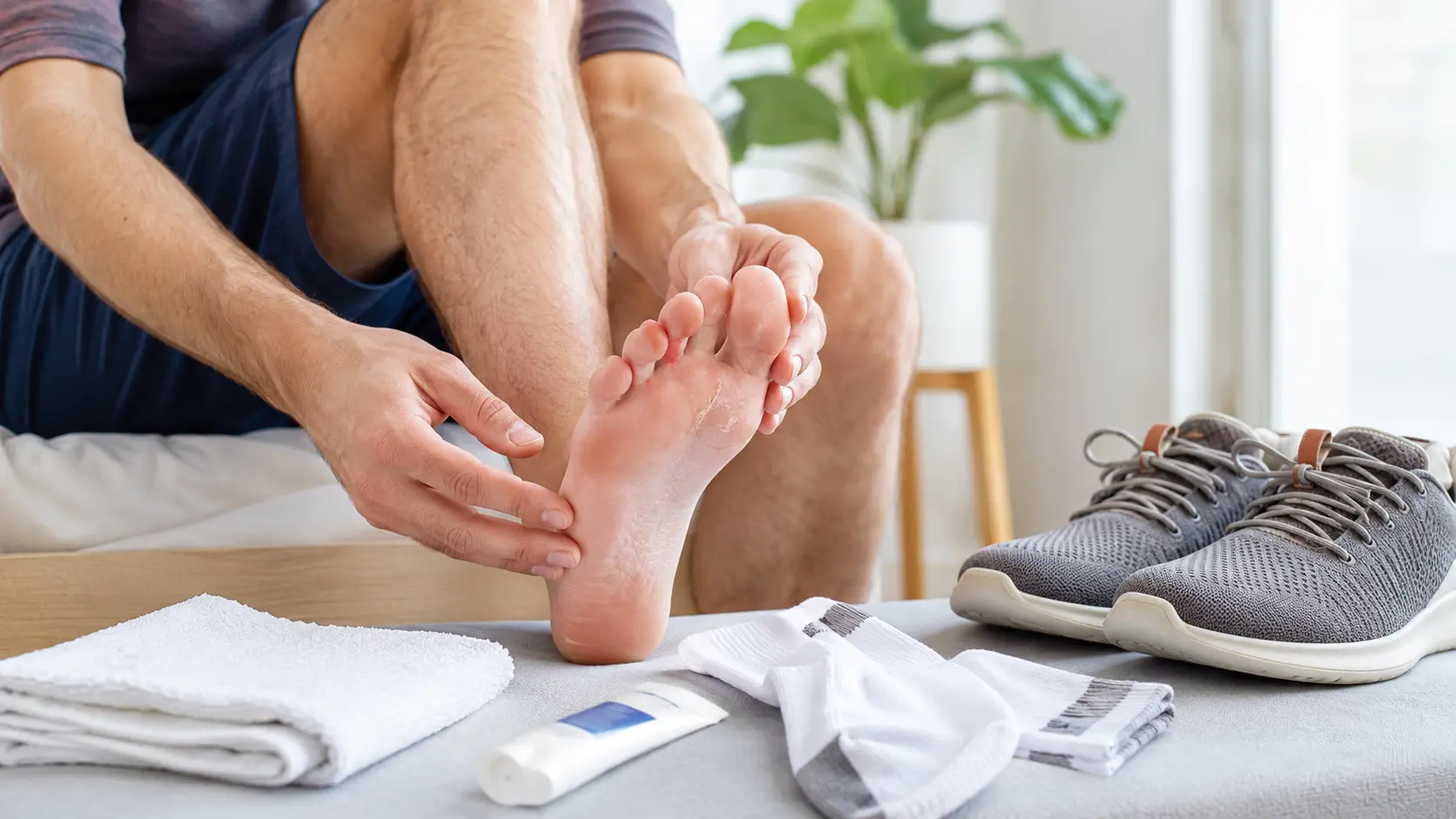
That persistent itch between your toes can be difficult to ignore.
Maybe the skin is peeling, burning, cracking, or turning white and soft after a long day in sweaty shoes. These are common signs of athlete’s foot—a fungal infection that can affect anyone, not just athletes.
When symptoms appear, many people immediately search their kitchen or bathroom cabinets for a quick fix.
Vinegar soaks, baking soda, coconut oil, hydrogen peroxide, garlic, and essential oils are frequently promoted online as natural athlete’s foot remedies.
Some may temporarily reduce moisture, odor, or discomfort, but they are not equally effective—and certain remedies can make irritated skin worse.
The most dependable at-home approach is straightforward: keep your feet clean and dry, reduce moisture inside your footwear, and use a proven over-the-counter antifungal product as directed.
Athlete’s foot, medically known as tinea pedis, is a form of ringworm caused by fungi rather than a worm.
It commonly affects the spaces between the toes but may also spread across the soles, sides, and toenails.
What Does Athlete’s Foot Look and Feel Like?
Athlete’s foot does not always look the same.
The appearance can depend on the part of the foot involved, how long the infection has been present, and whether the skin has become irritated or secondarily infected.
Common symptoms include:
- Itching, especially between the toes or after removing socks and shoes
- Burning or stinging
- Peeling, flaking, or scaly skin
- Cracked skin between the toes
- Dry, scaly patches on the soles or sides of the feet
- Whitish, softened skin between the toes
- Small fluid-filled blisters
- Raw, tender, or inflamed areas
- Unpleasant foot odor
The infection most often affects the skin between the toes, although dry scaling can also appear on the bottom and sides of the foot.
Not every itchy or peeling foot rash is athlete’s foot. Eczema, psoriasis, contact dermatitis, very dry skin, and bacterial infections can cause similar symptoms. A healthcare professional may need to examine or test the skin when the diagnosis is uncertain.
Athlete’s foot can also spread. Touching or scratching the infected area may transfer the fungus to the hands, groin, toenails, or other parts of the body.
It can also pass between people through contaminated towels, shoes, socks, floors, and shared wet surfaces.
The Most Effective Athlete’s Foot Home Treatment
The best home treatment does not depend on one miracle ingredient.
It combines antifungal medication with daily habits that make your feet less hospitable to fungal growth.
1. Use an Over-the-Counter Antifungal Product
An over-the-counter antifungal cream, spray, liquid, or powder is usually the most reliable starting point for a mild case of athlete’s foot.
Common active ingredients sold in US pharmacies include:
- Terbinafine
- Clotrimazole
- Miconazole
- Tolnaftate
- Butenafine
Product strengths, application schedules, and treatment durations vary. Read the label carefully and use the medication exactly as directed.
Some products are applied once daily, while others may require more frequent application.
Before applying an antifungal:
- Wash the affected area gently.
- Dry the foot completely, including between the toes.
- Apply a thin layer to the affected skin and the surrounding area according to the label.
- Wash your hands afterward.
- Continue for the full recommended treatment period.
Do not stop simply because the itching improves.
Symptoms can fade before the fungus has been fully controlled. The Centers for Disease Control and Prevention recommends using antifungal medication exactly as directed and for as long as directed.
The American Academy of Dermatology reports that an OTC antifungal cream or spray may clear a mild case of athlete’s foot, often within about two weeks.
2. Keep Your Feet Completely Dry
Fungi thrive in warm, damp environments.
Moisture control is therefore an essential part of both treatment and prevention.
After showering or washing your feet:
- Pat the skin dry with a clean towel.
- Dry carefully between every toe.
- Avoid rubbing cracked or inflamed skin.
- Do not put on socks while your feet are still damp.
- Consider using a hair dryer on a cool setting if reaching between the toes is difficult.
Use a separate towel for the infected foot when possible, and do not share that towel with anyone else.
3. Wash Your Feet Without Over-Scrubbing
Wash your feet once or twice daily with lukewarm water and mild soap. Gentle washing removes sweat and debris without causing additional damage.
Avoid aggressive scrubbing, pumice stones, or harsh exfoliation while the skin is cracked, peeling, or blistered.
Creating small breaks in the skin can increase irritation and may allow bacteria to enter.
Always wash your hands after applying medication or touching the affected area.
4. Change Damp Socks Promptly
Clean socks help, but dry socks matter even more.
Change your socks:
- At least once daily
- Immediately after exercise
- Whenever they become sweaty or damp
- After working for long periods in hot footwear
Moisture-wicking socks may be helpful for people whose feet sweat heavily.
Avoid returning damp socks to your feet, even when they do not look dirty.
5. Rotate and Air Out Your Shoes
Wearing the same damp pair every day can make athlete’s foot more difficult to control.
Whenever possible:
- Alternate between at least two pairs of shoes.
- Allow each pair to dry fully before wearing it again.
- Remove the insoles to improve airflow.
- Loosen the laces and open the shoes after use.
- Choose breathable footwear.
- Wear sandals or open shoes when safe and appropriate.
- Avoid wearing wet shoes.
Keeping feet clean, dry, and cool, wearing clean socks, and giving shoes time to dry are standard recommendations for preventing athlete’s foot and reducing recurrence.
6. Consider Antifungal Powder for Shoes
An antifungal powder or spray may help reduce fungal growth and moisture inside shoes.
This is particularly useful for people who sweat heavily or must wear closed footwear for long periods.
A powder used in shoes does not necessarily replace a cream or spray applied directly to infected skin. Use each product only for the purpose described on its label, and avoid inhaling loose powder.
Popular Natural Athlete’s Foot Remedies: Do They Work?
“Natural” does not automatically mean proven, gentle, or safe for damaged skin.
Many household remedies have limited clinical evidence, especially when compared with commercially available antifungal medications.
Vinegar Foot Soaks
Vinegar is acidic, which is why it is frequently suggested as a fungal remedy. However, strong evidence that vinegar reliably cures athlete’s foot is lacking.
A vinegar soak may also sting badly when the skin is cracked, raw, or blistered. Repeated exposure can increase dryness and irritation.
It should not replace a labeled antifungal treatment or delay medical care.
Baking Soda
Baking soda may absorb moisture and reduce odor when used cautiously inside dry footwear. That does not mean it can eliminate an established fungal infection.
Avoid vigorously rubbing baking soda onto peeling or cracked skin.
Its abrasive texture can worsen irritation and create additional skin damage.
Tea Tree Oil
Tea tree oil has shown antifungal activity in laboratory settings, but laboratory activity does not guarantee reliable results on an active foot infection.
Essential oils can cause burning, irritation, or allergic contact dermatitis. Undiluted tea tree oil should not be applied to cracked, blistered, or inflamed skin.
Anyone who develops increased redness, swelling, or burning after using it should wash the area and discontinue use.
Hydrogen Peroxide
Hydrogen peroxide is often viewed as a universal disinfectant, but repeated application can irritate healthy tissue and may interfere with normal skin recovery.
It is not a preferred treatment for athlete’s foot. Avoid applying it to open cracks, raw areas, or blisters unless a healthcare professional has specifically instructed you to do so.
Coconut Oil
Coconut oil may soften dry skin, but its usefulness as a treatment for established athlete’s foot is uncertain.
Applying a heavy layer between the toes may trap moisture, which can work against the goal of keeping that area dry. It should not be considered a substitute for an antifungal medication.
Garlic
Garlic is regularly promoted online because some of its compounds have antimicrobial properties. Directly applying crushed garlic to the skin, however, can cause severe irritation and burn-like reactions.
The potential for skin injury makes raw garlic an unsuitable first-line home remedy for athlete’s foot.
Saltwater and Epsom Salt Soaks
A warm soak may temporarily soothe tired or itchy feet, but it does not reliably eradicate the fungus.
Prolonged soaking can soften and weaken already damaged skin. When soaking is used for comfort, the feet must be dried thoroughly afterward, especially between the toes.
The Practical Bottom Line on Natural Remedies
The safest home-based strategy is not a complicated kitchen treatment. It is a consistent routine built around:
- A proven OTC antifungal
- Clean and thoroughly dried feet
- Fresh socks
- Dry, breathable footwear
- Proper shoe rotation
- Avoidance of irritants
Household ingredients may reduce odor or provide temporary comfort, but they should not be assumed to cure the infection.
A Simple Seven-Day Athlete’s Foot Care Routine
This routine can help you stay consistent during the first week of treatment.
Seven days is not necessarily the complete treatment duration—always follow the directions on your antifungal product.
Morning
- Wash your feet gently with mild soap and water.
- Dry them completely, paying close attention to the spaces between your toes.
- Apply the OTC antifungal as directed.
- Put on clean, dry socks.
- Wear breathable shoes that are fully dry inside.
After Exercise or Heavy Sweating
- Remove sweaty socks and footwear as soon as possible.
- Wash or rinse your feet.
- Dry them thoroughly.
- Change into fresh socks.
- Place damp shoes in a ventilated area to dry.
Evening
- Examine your feet for worsening cracks, blisters, redness, or drainage.
- Wash and dry the affected area.
- Reapply medication if required by the product directions.
- Leave your feet uncovered for a while when practical.
- Prepare a clean, dry pair of socks and shoes for the next day.
The most important factor is consistency.
Skipping treatment, rewearing damp socks, or repeatedly placing treated feet inside wet shoes can slow improvement.
Common Mistakes That Can Make Athlete’s Foot Worse
Stopping Treatment Too Early
Less itching does not always mean the infection is gone.
Complete the full course specified on the product label, even when your feet begin to look better.
Using Hydrocortisone Alone
Hydrocortisone and other topical corticosteroids reduce inflammation, but they do not kill the fungus responsible for athlete’s foot.
Steroid creams can temporarily hide redness and itching while allowing a fungal infection to worsen or change appearance.
The CDC specifically advises against using steroid creams or ointments on ringworm or on a rash that may be ringworm.
Avoid combination steroid-antifungal products unless they have been recommended by a qualified healthcare professional for your specific condition.
Covering the Feet All Day
Tight, nonbreathable shoes trap heat and moisture. When practical, give your feet and footwear opportunities to air out.
Rewearing Sweaty Socks
Socks can look clean while still holding moisture. Replace them whenever they become damp.
Scratching or Pulling Off Peeling Skin
Scratching can spread the fungus and damage the skin.
Pulling away loose skin may create painful cracks or bleeding areas that are more vulnerable to bacterial infection.
Sharing Towels, Shoes, or Nail Tools
Do not share:
- Towels
- Socks
- Shoes
- Nail clippers
- Foot files
- Pumice stones
- Pedicure tools
Shared objects can transfer fungal organisms to other people or reintroduce them to treated skin.
Treating the Feet but Ignoring the Shoes
Even an effective antifungal routine can be undermined by repeatedly wearing damp footwear.
Air out shoes, rotate pairs, and use an antifungal shoe product when appropriate.
Assuming Every Rash Is Athlete’s Foot
A rash that is unusually painful, severely swollen, rapidly spreading, or unresponsive to antifungal treatment may have another cause.
Continuing to self-treat the wrong condition can delay appropriate care.
How to Prevent Athlete’s Foot From Coming Back
Athlete’s foot often returns when the environment that supported it remains unchanged.
Use these habits to reduce recurrence:
- Wash your feet daily.
- Dry carefully between the toes.
- Wear clean socks every day.
- Replace socks after exercise or heavy sweating.
- Rotate shoes and allow them to dry fully.
- Choose shoes made from breathable materials.
- Avoid walking barefoot in public showers, locker rooms, pool areas, and similar wet spaces.
- Wear shower shoes, sandals, or flip-flops in communal areas.
- Do not share footwear, socks, towels, or nail tools.
- Keep toenails clean and trimmed.
- Treat athlete’s foot promptly before it spreads to the nails.
- Wash towels and socks regularly.
- Continue good foot hygiene after symptoms disappear.
Dermatologists recommend protective footwear around pools, gyms, locker rooms, communal showers, and hotel rooms because the fungi that cause athlete’s foot may remain on floors.
When Should You See a Doctor?
A mild case may respond to OTC treatment, but home care is not appropriate for every situation.
Contact a healthcare professional when:
- The rash has not improved after approximately two weeks of correctly used OTC antifungal treatment.
- It continues to spread or repeatedly returns.
- You are unsure whether the rash is fungal.
- The condition is severe or covers a large area.
- The skin becomes increasingly painful, hot, or swollen.
- You notice pus, drainage, red streaks, or fever.
- Cracks are deep, bleeding, or worsening.
- Blisters are extensive or appear infected.
- A toenail becomes thick, brittle, discolored, or distorted.
- You have poor circulation, reduced sensation, or a weakened immune system.
- The affected person is a young child.
People with diabetes should seek professional advice promptly when they suspect athlete’s foot.
Diabetes can reduce sensation and impair healing, making apparently minor foot problems more consequential.
Mayo Clinic also recommends medical evaluation for a foot rash that does not improve after two weeks of OTC antifungal use and for signs of infection such as swelling, pus, or fever.
Athlete’s Foot Remedies at a Glance
| Remedy or Action | What It May Do | Evidence | Main Caution |
|---|---|---|---|
| OTC antifungal | Directly treats the fungal infection | Best-supported home option | Follow the label and complete treatment |
| Thorough drying | Reduces the damp environment fungi prefer | Strong supportive measure | Dry gently between the toes |
| Fresh socks | Controls sweat and reduces reinfection | Strong supportive measure | Change whenever damp |
| Shoe rotation | Gives footwear time to dry | Strong supportive measure | Do not rewear wet shoes |
| Antifungal shoe powder | Helps manage moisture and fungi in footwear | Useful supportive option | Avoid inhaling the powder |
| Vinegar soak | May temporarily change the skin environment | Limited evidence | Can sting or irritate cracked skin |
| Baking soda | May absorb odor and moisture | Limited evidence for treating infection | Do not scrub damaged skin |
| Tea tree oil | Has possible antifungal activity | Limited and inconsistent evidence | May cause irritation or allergy |
| Hydrogen peroxide | May temporarily clean the skin surface | Not a preferred treatment | Can irritate healing tissue |
| Coconut oil | May soften dry skin | Limited evidence for fungal clearance | May trap moisture between toes |
| Garlic | Contains antimicrobial compounds | Insufficient evidence for safe treatment | Can cause burn-like irritation |
| Salt or Epsom soak | May temporarily soothe discomfort | Does not reliably eliminate fungus | Dry feet completely afterward |
The Bottom Line
Athlete’s foot is a fungal infection, not simply a problem of dirty or sweaty feet.
Keeping your feet dry can make conditions less favorable for fungal growth, but moisture control alone may not eliminate an established infection.
For most mild cases, the most dependable at-home plan combines three things:
- Apply a proven over-the-counter antifungal exactly as directed.
- Keep the feet—especially the spaces between the toes—clean and completely dry.
- Change damp socks, rotate shoes, and avoid re-exposure in communal wet areas.
Viral remedies such as vinegar, tea tree oil, hydrogen peroxide, coconut oil, and garlic may sound appealing, but their evidence is limited and several can irritate already damaged skin.
Treat the fungus, dry the shoes, change the socks, and pay attention to warning signs.
When symptoms persist, worsen, or show signs of bacterial infection, professional evaluation is safer than continuing to experiment with household ingredients.
This article provides general health information and is not a substitute for diagnosis or treatment from a qualified healthcare professional.