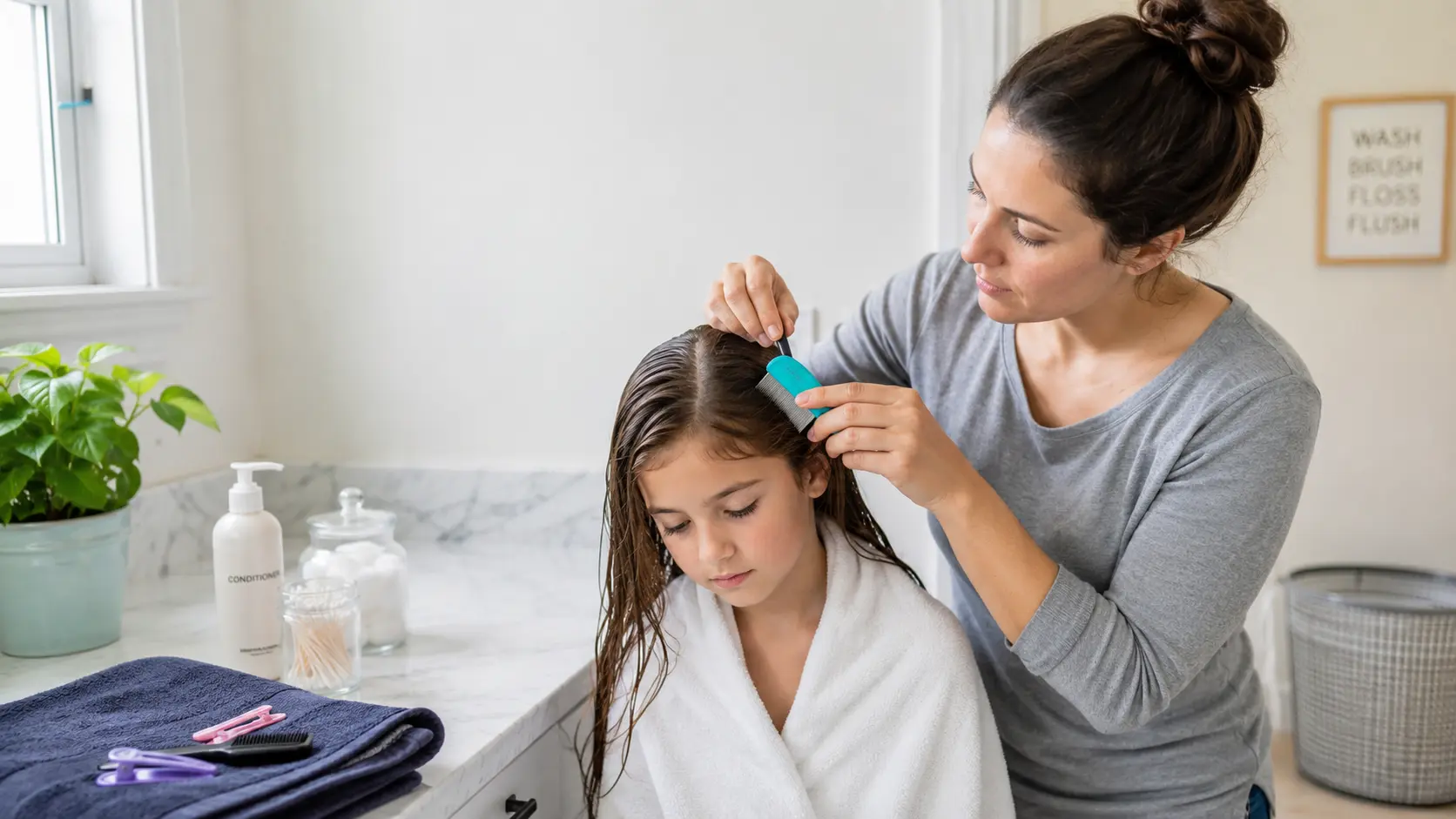
You notice your child scratching behind their ears. Then comes the dreaded message from school: someone in the class has head lice.
Before you reach for mayonnaise, vinegar, essential oils, or every cleaning product in the house, take a breath.
Head lice are frustrating, but they are manageable. They are also not a sign that someone is dirty or has poor hygiene.
The key is knowing which at-home methods can genuinely help, which popular remedies are unsupported, and how to prevent lice from returning.
Although many people search for a quick natural cure, there is little reliable evidence that common household ingredients can eliminate an entire lice infestation.
The most practical non-medicated approach is careful, repeated combing. Approved lice treatments may also be necessary, particularly when live lice continue to appear.
Here is a safe, step-by-step guide to dealing with head lice at home.
First, Make Sure It Is Actually Head Lice
Not every itchy scalp or white speck in the hair is caused by lice. Dandruff, dried hair products, scabs, sand, and other debris can easily be mistaken for lice eggs.
An accurate diagnosis matters because unnecessary treatments can irritate the scalp and waste valuable time.
Signs of head lice
Possible signs include:
- A tickling or crawling sensation on the scalp
- Persistent itching, particularly behind the ears and near the neck
- Irritability or difficulty sleeping
- Red bumps or sores caused by scratching
- Tiny insects moving through the hair
- Eggs attached firmly to individual hair shafts
Live adult lice are small, fast-moving insects that usually stay close to the scalp.
Their eggs, commonly called nits, are attached to hair strands and can be difficult to remove.
Nits versus dandruff
Dandruff generally flakes off or moves when you brush the hair. Nits tend to remain stuck to the hair shaft.
However, even finding something that looks like a nit does not always confirm an active infestation.
Old or empty egg casings can remain in the hair after the lice have been eliminated. Finding a live, crawling louse is the strongest evidence that active lice are present.
Mayo Clinic advises getting confirmation from a healthcare professional when you are uncertain, noting that many children receive lice treatments even though they do not actually have lice.
The Most Reliable Non-Medicated Home Method: Wet-Combing
Wet-combing is the physical removal of lice and nits using a specialized fine-toothed comb.
It does not depend on a household substance poisoning or suffocating the lice.
This method can be useful for families who prefer to avoid medication, but it requires patience, good lighting, close attention, and repeated sessions.
A single quick comb-through is unlikely to be enough.
What you need
Gather the following supplies:
- Regular shampoo
- Hair conditioner
- A fine-toothed metal lice or nit comb
- Hair clips
- A regular detangling comb
- White paper towels
- A towel for the shoulders
- Bright lighting
- A magnifying glass, if helpful
A metal nit comb with closely spaced teeth is generally easier to use for removing lice than an ordinary hair comb.
How to wet-comb the hair
- Wet and wash the hair.
Shampoo the hair normally, then leave it damp. - Apply conditioner.
Conditioner reduces tangling and helps the lice comb move through the hair. Remember that conditioner should not be used immediately before certain medicated lice products unless the label permits it. - Detangle the hair.
Use a regular comb to remove knots before switching to the lice comb. - Divide the hair into small sections.
Secure untreated sections with clips. Smaller sections are easier to inspect thoroughly. - Start at the scalp.
Place the lice comb as close to the scalp as comfortably possible. - Comb from roots to ends.
Pull the comb slowly through the full length of the hair. - Check the comb after every pass.
Wipe it on a white paper towel so that lice and nits are easier to see. - Rinse or clean the comb frequently.
- Repeat each section.
Continue until the entire scalp and all the hair have been carefully combed. - Recheck the hair regularly.
Repeat combing according to a consistent schedule until no live lice are found.
Mayo Clinic includes wet-combing among the physical methods used to address head lice, while also emphasizing that most home remedies have little or no supporting evidence.
Wet-combing thick, curly, coily, or long hair
Wet-combing can take longer when the hair is thick or tightly textured, but the basic process remains the same.
Use plenty of conditioner, work in very small sections, detangle carefully, and keep completed sections separate from untreated hair.
Avoid pulling hard against knots, since this can cause pain and hair breakage.
The goal is not to finish as quickly as possible. The goal is to pass the comb thoroughly from the scalp to the ends of every section.
Common wet-combing mistakes
Wet-combing is less likely to work when people:
- Use an ordinary comb instead of a proper nit comb
- Begin too far away from the scalp
- Work with sections that are too large
- Skip the areas behind the ears and at the nape of the neck
- Stop after one session
- Fail to inspect the comb after each pass
- Assume every white speck is a live egg
Consistency matters more than aggressive combing.
Do Popular Home Remedies for Lice Actually Work?
The internet is full of home remedies that claim to kill lice naturally.
Unfortunately, popularity is not the same as clinical evidence.
Some household products may make the hair slippery and easier to comb. That does not mean they reliably kill lice or their eggs.
Conditioner
Hair conditioner can be useful as a combing aid. It reduces friction and makes it easier to move a lice comb through tangled hair.
However, conditioner should not be treated as a guaranteed lice cure. It supports physical removal rather than reliably killing every stage of the insect’s life cycle.
Also check the directions before using a medicated lice product.
Some treatments should not be applied after conditioner because the coating on the hair may interfere with the product.
Vinegar
Vinegar is often promoted as a way to dissolve the substance that holds nits to hair.
There is not enough reliable evidence to conclude that vinegar can eliminate head lice. It may also sting or irritate skin that has already been scratched.
Never apply strong or undiluted vinegar to an inflamed child’s scalp.
Mayonnaise
Mayonnaise is one of the best-known home remedies for lice. The theory is that a thick layer will smother the insects.
However, the American Academy of Pediatrics’ parent guidance states that mayonnaise and similar substances have not been proven effective as head-lice treatments.
Mayonnaise is also messy, difficult to remove, and unlikely to solve the problem if live lice or viable eggs remain.
Olive oil and coconut oil
Oils may slow lice temporarily or make the hair easier to comb. That does not establish them as reliable stand-alone treatments.
Olive oil and similar home remedies have not been supported by adequate studies showing that they consistently eliminate an infestation.
Use oils only with realistic expectations. They should not replace systematic combing or an approved treatment when one is needed.
Petroleum jelly
Petroleum jelly is difficult to distribute evenly and extremely difficult to wash out of hair.
It has not been proven to reliably eradicate lice. It may leave families with greasy hair and an infestation that is still active.
Tea tree oil and other essential oils
Essential oils are frequently described online as natural insect killers. However, “natural” does not automatically mean safe or effective.
Evidence for essential oils as head-lice treatments remains limited, and these products can cause skin irritation or allergic reactions.
Concentrated essential oils should never be applied directly to a child’s scalp.
The American Academy of Pediatrics’ parent guidance lists essential oils among the home remedies that lack adequate proof of effectiveness.
Hot hair dryers
Trying to kill lice with extremely hot air can burn the scalp and damage the hair.
Heat becomes especially dangerous when oils, alcohol-based products, kerosene, gasoline, or other flammable substances are present. Mayo Clinic specifically warns against dangerous heat-based and flammable home treatments.
Dangerous DIY Lice Treatments to Avoid
Some home remedies are merely inconvenient or ineffective. Others can cause serious injury.
Never apply any of the following to a person’s hair or scalp:
- Gasoline
- Kerosene
- Bleach
- Paint thinner
- Household insecticide
- Garden pesticide
- Flea or tick shampoo intended for pets
- Industrial solvents
- Any flammable liquid
These substances may cause chemical burns, poisoning, breathing difficulties, eye injuries, or fires.
Products made for animals should never be used on humans. Household pesticide sprays should not be applied to the scalp, furniture, bedding, or mattresses as a lice treatment.
Mayo Clinic warns against flammable substances such as gasoline and kerosene, as well as animal flea products, because they are unsafe and are not appropriate treatments for human head lice.
A Practical At-Home Lice Removal Plan
A calm, organized plan is more effective than trying several remedies at once.
Step 1: Check everyone in the household
Inspect household members and other people who have had close head-to-head contact with the affected person.
Concentrate on:
- Behind the ears
- The crown of the head
- The nape of the neck
- Hair close to the scalp
Do not automatically treat everyone merely because one person has lice.
Treatment should generally be directed toward people with confirmed live lice or according to professional advice.
Step 2: Choose a treatment approach
There are two main at-home routes.
Option A: Careful wet-combing
This option avoids lice-killing medication but requires repeated, meticulous removal.
It may be appropriate when:
- The infestation is caught early
- Medication cannot be used
- The family is willing to repeat the process carefully
- A healthcare professional recommends physical removal
Option B: An approved over-the-counter lice treatment
Several lice products are available without a prescription in the United States.
Age limits, application instructions, treatment times, and the need for a second application differ between products.
Read the entire label before beginning. Use only the stated amount, keep the product away from the eyes and mouth, and do not repeat treatment more often than directed.
Topical ivermectin 0.5% lotion, for example, was approved by the FDA for nonprescription use for head lice in people six months of age and older. It is intended for use on the scalp and dry hair according to its label.
Do not use oral ivermectin, veterinary ivermectin, or another prescription product unless a licensed healthcare professional specifically prescribes it.
Step 3: Comb through the hair
Even when using a medicated product, combing can help remove lice, eggs, and empty casings.
Follow the product instructions concerning when combing should begin.
Some labels provide specific directions about washing, conditioning, nit removal, and follow-up inspection.
Step 4: Recheck according to the product schedule
Some lice treatments kill crawling insects more effectively than eggs. As a result, newly hatched lice may appear after the first treatment.
Do not guess when to repeat the product.
Follow the exact retreatment interval on the package or the instructions provided by a healthcare professional.
Using more product, leaving it on longer, or applying it more frequently does not necessarily improve effectiveness and may increase irritation or other risks.
Step 5: Reduce the chance of reinfestation
During treatment:
- Avoid direct head-to-head contact
- Do not share combs or brushes
- Do not share hats, scarves, towels, helmets, or hair accessories
- Check close contacts
- Keep long hair tied back when appropriate
- Inform relevant caregivers or close contacts discreetly
Head lice spread mainly through direct contact with the hair of an infested person, particularly during play, sports, sleepovers, camps, and other close-contact activities.
How to Clean Your Home After Finding Lice
Finding lice does not mean you need to disinfect your entire home.
Head lice are adapted to living on the human scalp. Cleaning should focus on items that recently came into contact with the affected person’s head.
Wash recently used items
The CDC recommends machine-washing and drying clothing, bedding, and other washable items used during the two days before treatment.
Use hot water at approximately 130°F and a high-heat dryer when the fabric permits.
Possible items include:
- Pillowcases
- Sheets
- Recently worn clothing
- Towels
- Fabric hats
- Scarves
- Washable hair accessories
Always consider fabric-care instructions.
Clean combs and brushes
Remove visible hair from brushes and combs.
The CDC recommends soaking these items in water that is at least 130°F for 5 to 10 minutes.
Handle hot water carefully to prevent burns, particularly when children are nearby.
Handle items that cannot be washed
Items that cannot be washed or dry-cleaned may be sealed in a plastic bag for two weeks, according to CDC guidance.
There is usually no need to throw away toys, pillows, helmets, or stuffed animals.
Vacuum relevant areas
Vacuum areas where the affected person recently sat or lay, such as:
- A favorite chair
- A car seat
- A sofa
- A rug near the bed
- The child’s sleeping area
Extensive deep-cleaning is unnecessary. Do not spray furniture, mattresses, floors, or carpets with pesticide.
What you do not need to do
You generally do not need to:
- Replace mattresses
- Throw away bedding
- Discard stuffed animals
- Fumigate the house
- Use insecticide foggers
- Spray the car with pesticide
- Treat cats or dogs
Human head lice do not live on household pets.
How to Keep Lice From Spreading
Lice prevention is mostly about reducing direct hair contact and avoiding shared personal items.
Limit head-to-head contact
Children may have prolonged hair contact during:
- Sleepovers
- Group photos and selfies
- Contact sports
- Playground activities
- Camps
- Shared sleeping arrangements
- Close play on the floor or couch
You do not need to isolate a child completely.
Instead, teach them to avoid pressing their hair directly against another person’s hair until treatment is underway.
Avoid sharing hair and head items
Do not share:
- Combs
- Brushes
- Hair clips
- Hair ties
- Hats
- Scarves
- Towels
- Helmets
- Headphones that touch the hair
- Pillows
The risk from objects is lower than the risk from direct head-to-head contact, but keeping personal hair items separate is still sensible during an infestation.
Talk about lice without shame
Children can feel embarrassed when lice are discussed as if they resulted from being dirty.
Remind them that lice can affect anyone. The insects do not choose people based on cleanliness, income, home size, or parenting.
Keep the conversation calm and practical. Avoid blaming another child, family, school, or caregiver.
How Long Does It Take to Get Rid of Head Lice?
Lice removal is usually a process rather than a single event.
The exact timeline depends on:
- How quickly the infestation was identified
- Which treatment was selected
- Whether the product kills eggs
- Whether retreatment is required
- How carefully the hair is combed
- Whether another close contact remains untreated
- Whether the lice are less responsive to the chosen product
Itching may continue temporarily even after the lice have been killed because the scalp may remain irritated.
Similarly, nits or empty egg casings can remain attached to the hair after successful treatment.
The most important sign of an ongoing infestation is the continued presence of live crawling lice.
Why Lice Treatments Sometimes Fail
Treatment failure does not always mean the product is ineffective.
The diagnosis was wrong
Dandruff, scabs, hair casts, dried products, and debris are often mistaken for lice eggs.
Treating the wrong condition will not resolve itching or scalp irritation.
The directions were not followed
Treatment may fail when:
- Too little product is applied
- The hair is too wet or too dry
- The product is rinsed off too soon
- Conditioner is used when the label prohibits it
- Part of the scalp is missed
- Retreatment is skipped
- The second application is performed at the wrong time
Follow the label rather than relying on general instructions from social media.
Eggs survived
Some treatments do not kill every egg. Newly hatched lice may therefore appear days after treatment.
This is why inspection and correctly timed follow-up are essential.
Reinfestation occurred
A successfully treated person can acquire lice again through close head-to-head contact with someone who still has an infestation.
Check relevant household members and close contacts rather than repeatedly treating only one person.
The lice may be resistant
In some situations, lice may respond poorly to a commonly used active ingredient.
Do not keep reapplying the same product beyond label directions.
Contact a pediatrician, dermatologist, pharmacist, or other healthcare professional for advice about an alternative.
When to Call a Doctor or Pediatrician
Contact a healthcare professional when:
- You cannot confirm whether the problem is lice
- The affected child is younger than the product’s approved age
- The person is pregnant or breastfeeding
- The infestation involves the eyebrows or eyelashes
- The scalp is severely red, swollen, painful, or bleeding
- Scratching has caused sores or possible infection
- Pus, spreading redness, fever, or worsening pain develops
- Live lice remain after treatment was used correctly
- Several products have already failed
- The person has significant allergies, asthma, seizures, or another medical condition
- You are unsure which treatment is safe
A clinician can confirm the diagnosis, evaluate the scalp, and recommend an age-appropriate treatment.
Can a Child Go to School With Head Lice?
School rules vary, so families should check the policy of their school or district.
However, the CDC states that a student diagnosed with head lice does not need to be sent home early. The student can finish the school day, receive appropriate treatment, and return after treatment has begun.
The CDC also notes that nits may remain after successful treatment. Therefore, the presence of nits alone does not necessarily mean that a child still has active, crawling lice.
Keeping children out of school solely because a few nits remain can lead to unnecessary missed learning and stigma.
The Bottom Line
When you find head lice, do not panic and do not cover the scalp with whatever remedy is trending online.
Start by confirming that live lice are actually present. Then use careful wet-combing, an age-appropriate approved treatment, or a plan recommended by a healthcare professional.
Remember the five C’s:
Confirm, Comb, Clean, Check again, and Call a professional if treatment fails.
Focus household cleaning on recently used bedding, clothing, brushes, and combs. Avoid extreme deep-cleaning, pesticide sprays, pet treatments, flammable chemicals, and unproven DIY mixtures.
Mayonnaise, vinegar, petroleum jelly, oils, and essential oils may be popular online, but they have not been shown to reliably eliminate an entire lice infestation.
Lice removal does not require shame, panic, or dangerous home chemistry. It requires the right treatment, thorough combing, and consistent follow-up.
Medical disclaimer: This article provides general educational information and is not a substitute for diagnosis or treatment from a licensed healthcare professional. Always follow product labels and seek professional advice for infants, pregnancy, scalp infection, uncertain diagnosis, or treatment failure.